Devorah and Bubby’s relationship
Unorthodox: The Scandalous Rejection of My Hasidic RootsDevorah and Bubby’s relationship joins the practical intimacy of a child raised by her grandparents to the strain of questions that religious answers cannot settle. Bubby cares for Devorah after her mother disappears, and Devorah turns to her with questions about evil, suffering, and divine love. Bubby offers explanations and family memories; Devorah listens, but does not always accept the meanings her grandmother gives them. Their closeness is therefore neither simple reassurance nor open estrangement: it is a relationship in which inherited belief is passed down and quietly challenged.
Caregiving and the Questions Devorah Brings to Bubby
After Devorah’s parents’ marriage begins to fall apart soon after her birth, her mother leaves to pursue higher education, and Devorah remains in the care of Bubby and Zeidy. They had thought they were finished raising children, so Devorah wonders whether her presence is another burden or even a divine test for them. The text does not present that fear as evidence that her grandparents reject her; it shows instead how the family circumstances leave her trying to understand her place in a household already shaped by hardship.
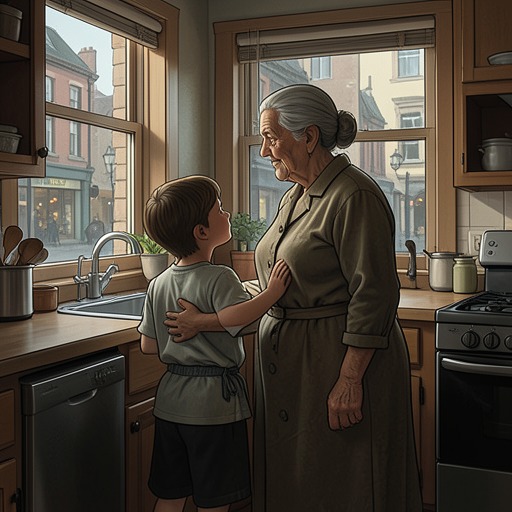
Devorah’s questions find a direct audience in Bubby. While the two are doing the dishes together, Devorah asks whether bad things come from Hashem. Bubby answers that they come from Satan, not God. The exchange takes place amid an ordinary household task: Bubby dries the dishes with a red-checkered tea towel while Devorah puts them away. That practical routine gives the theological conversation a familiar setting, but it does not make the answer convincing to Devorah. She reasons that if God created everything, God must also have created Satan, and she cannot understand why God would allow evil to operate or fail to stop it.
The question is not abstract for Devorah. She connects it to her father’s limitations and to her own experience of being left in her grandparents’ care, then wonders whether God or Satan is responsible for her distress. Bubby’s explanation establishes her as someone Devorah can ask, but it does not resolve the child’s doubts. Devorah continues to imagine God as powerful enough to be accountable for what happens, and the gap between that reasoning and Bubby’s answer becomes one of the defining tensions in their relationship.
Warnings, Belonging, and Fear
Bubby also teaches Devorah to expect danger beyond the family. She tells her that persecution of Jews has recurred across history and warns her not to trust non-Jews, even when they seem kind. Her account presents Jewish vulnerability as persistent and beyond human control. Devorah, still young, struggles to picture a world full of people who hate her before they have even met her. Because her absent mother has left the community, Devorah wonders whether her mother now belongs among those people and whether that means she hates her daughter too.
Bubby dismisses that possibility by insisting that Jewish identity cannot be erased, even by someone who changes how she dresses, speaks, or lives. The response asserts an enduring bond to Jewishness, but it does not settle Devorah’s more intimate fear of being unloved. At night she lies awake with pain in her belly and wonders whether God loves her or might send another persecutor to kill her. She feels rejected by people who regard her as evidence of family scandal and fears that God, too, has forgotten her. Those feelings are described as Devorah’s, not as a judgment on Bubby’s care; they show the limits of reassurance in a childhood marked by her mother’s absence and warnings about danger.
The contrast between Bubby’s warnings and Devorah’s longing for her mother also appears in a dream. In it, imagined pursuers sweep through Williamsburg, and Devorah escapes with her mother, who arrives to rescue her. The dream gives Devorah the protection she cannot find in the waking account of inherited danger. Bubby’s teaching helps frame what Devorah fears, while the dream reveals that the child’s deepest imagined rescue comes from her absent mother, not from the explanations her grandmother can provide.
Family Memory and the Meaning of Suffering
Bubby’s recollections offer another way of understanding hardship. She tells Devorah that people today complain about lacking fine clothes or a good car, whereas in her own childhood even a scrap of food was a source of gratitude. What mattered then, she says, was having one another. The memory presents Bubby’s outlook as formed by deprivation and family solidarity. It also gives Devorah a standard against which to measure her own suffering, though it does not erase her sense of loneliness.
Among the stories Bubby sometimes shares is that of her mother, Chana Rachel, one of seven children in a family devastated by a diphtheria epidemic. By the time Chana Rachel married, only two siblings remained. When Chana Rachel herself became seriously ill as a child, her mother acted in desperation to help her breathe, and Chana Rachel recovered. Bubby repeatedly attributed the recovery to prayer. Devorah, however, sees courage and decisive action in the great-great-grandmother’s intervention. The story thus passes between generations with two interpretations: for Bubby, faith explains the rescue; for Devorah, the mother’s refusal to remain passive is its striking feature.
A Bond That Carries Belief Forward and Opens a Difference
Devorah is moved by the story and imagines Chana Rachel as a fearless woman who made her own miracle. She wants to become such a person rather than wait for God to act. The account marks a consequential difference between granddaughter and grandmother, but not a severing of their bond: Bubby’s family memory supplies the very example through which Devorah begins to formulate her own ideal of action.
On Yom Kippur, Devorah still murmurs the prayers alongside the people around her, but she no longer approaches them as a straightforward request for mercy. Her anger at suffering and her doubts about divine justice have altered what the inherited prayers mean to her. Bubby remains a source of religious language, warnings, and family history, yet Devorah makes a distinct interpretation from what she receives. Their relationship matters because it holds both transmission and difference: the grandmother gives the child stories and explanations, while the child’s questions and reading of those stories begin to make room for a self-directed response.